
Why we’re sharing this
I’m Ryan, Monica’s husband. I’m a data scientist with type 1 diabetes, not a doctor, and nothing here is medical advice. After five years of trying nearly every medication for Monica’s bipolar II disorder, we tried something different: fecal microbiota transplantation (FMT). We’re sharing the whole record, including the parts that didn’t go to plan, because the story that gave us hope was someone else’s willingness to share theirs. Monica has agreed to everything on this page.
Meet Monica
Monica is a local artist, cat lover, Duke basketball fan, glitter scientist, color queen, and rainbow enthusiast.
The condition: bipolar II disorder
Bipolar II disorder is a mood disorder marked by episodes of major depression and at least one episode of hypomania: a period of elevated or irritable mood and increased energy that is milder than the full mania of bipolar I. Most of the illness burden is depression. It is not a “milder” bipolar disorder: it carries a high risk of suicide and higher rates of metabolic syndrome and type 2 diabetes (JAMA, 2023).
How it started
Looking back, the first piece may have been in 2019, when Monica had three rounds of antibiotics for a recurring lung infection. In May 2020 she lost her hotel-industry job to COVID. That July we left Washington, D.C. for Colorado on short notice, a decision that in hindsight had some hypomania in it, and in September 2020 she was diagnosed with bipolar II disorder.
From 2020 to 2025 Monica tried most of the available medications, mainly atypical antipsychotics and mood stabilizers, one at a time and without lasting gains. Life went on around them: we formed a civil union in April 2021 and married in May 2022. In May 2023 she was diagnosed with type 2 diabetes, a known risk with some of these medications and with bipolar disorder itself. By December 2025 we were running out of options.
Finding another path
In 2023 or 2024 I came across Jane Dudley, an Australian woman who treated her bipolar I disorder with FMT in 2016 and shares her story at Microbiome in Mind. By late 2025, with little left to try, we decided to try it too.
I couldn’t be Monica’s donor: with type 1 diabetes, an autoimmune condition, there’s a real risk of passing on what lives in my gut. In February 2026 we found an online provider of screened donor stool, delivered freeze-dried as capsules. Before starting, Monica took a home microbiome test as a baseline, and she logged her mood and sleep every day in the eMoods app.
This is not a how-to. FMT outside a clinical trial or a clinician's care carries real risks, including infection and transferring conditions from a donor. Donor screening matters enormously. Please talk with a qualified clinician before considering it, and don't stop psychiatric medication without medical supervision.
What we’ve tried
| Treatment | When | Outcome | Notes |
|---|---|---|---|
| FMT capsules, new round See the research | Jul 2026 to present | Too early to tell | Doses of leftover April stool on July 26, August 5 and 11 as depression returned, then fresh screened donor stool from August 19, alongside more fiber and fermented foods to help it take hold. |
| FMT capsules, first rounds See the research | Feb 2026 to Apr 2026 | Mixed | Seven doses from two screened donors (Feb 4 to 28), then March 25 and April 22. Depression lifted for about four months, but elevated mood rose and sleep fell. See the data. |
| Talk therapy | Before 2026 to present | Ongoing | Regular sessions throughout, logged in eMoods. |
| Atypical antipsychotics and mood stabilizers See the research | 2020 to present | Some benefit | Tried most available options one at a time from 2020 to 2025 without lasting gains. Stopped after the April 2026 FMT; one antipsychotic restarted as a precaution when sleep dropped below five hours. |
What the data shows
| Period | Days | Depressed mood | Elevated mood | Sleep (hrs) |
|---|---|---|---|---|
| Before FMT (Jan 1 – Feb 3) | 34 | 3.6 | 2.5 | 14.8 |
| First FMT course (Feb 4 – 28) | 25 | 3.2 | 2.6 | 11.8 |
| March | 31 | 2.5 | 3.1 | 8.3 |
| April | 30 | 1.5 | 3.8 | 5.3 |
| May | 31 | 1.6 | 3.7 | 5.8 |
| June | 30 | 1.5 | 3.7 | 4.9 |
| July | 31 | 1.9 | 3.4 | 5.9 |
| August 1–14 | 14 | 3.3 | 2.4 | 11.2 |
Before FMT, Monica’s depression was severe most days and she was in bed up to 20 hours a day.
During and after the first course (seven doses, February 4 to 28), depressed mood eased through March. After further doses on March 25 and April 22, Monica stopped all of her bipolar medications. From April through July her depressed mood was mostly “none”. For those months, I had my wife back.
It wasn’t only good news. Elevated mood also rose and stayed high, and her sleep fell to about five hours a night, sometimes less. On April 12 she logged psychotic symptoms. In bipolar disorder that pattern can be hypomania, so as a precaution we restarted one of her antipsychotic medications.
In August, depression came back. As her mood started to slip, Monica took the stool we had left from April (July 26, August 5 and August 11), but by August 9 her depressed mood was severe again and she was sleeping 11 to 20 hours a day. Stool stored since April may not have survived. We also think her gut slipped back toward dysbiosis: we didn’t keep to the high-fiber diet that helps transplanted microbes take hold, and atypical antipsychotics may themselves disrupt the gut microbiome. On August 19 she started a new round with fresh stool. The data here ends August 14.
This is one person’s self-reported data, with medication changes, diet, and life happening at the same time. It shows what happened to Monica, not what FMT does in general.
Her microbiome, before and after
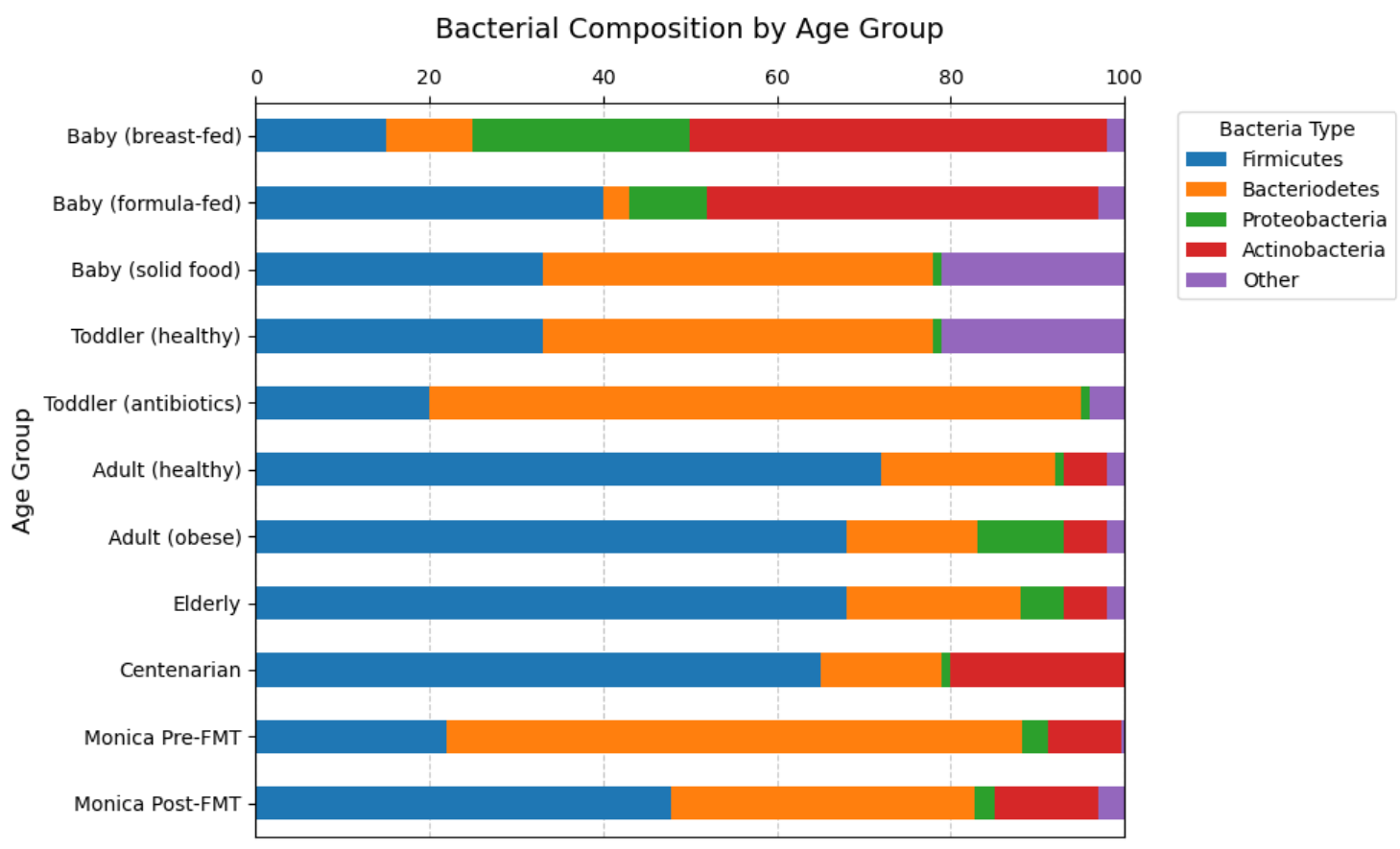
Monica took two home stool tests from different companies, so the scores aren’t directly comparable, but the direction is clear:
- Before FMT (Thorne, January 2026): high scores for inflammation and gut-brain imbalance, a microbiome very unlike healthy adults’ (97% beta-diversity dissimilarity), and very low levels of butyrate producers often linked with mood, including Faecalibacterium prausnitzii, Coprococcus, and Roseburia. The pathogen screen was normal.
- After the April round (Jona, April 28, 2026): above-average diversity (4.12, normal range 2.80 to 3.99), a Firmicutes-to-Bacteroidetes ratio of 1.37, and “excellent” ratings for most gut, metabolic, and inflammation categories. Brain health rated “fair”, and two potential pathogens (Bilophila wadsworthia and Bacteroides fragilis) were flagged for follow-up.
Which key bacteria moved into range
Most of the helpful, butyrate-producing bacteria that were low before FMT were in range or above it after the April round. Faecalibacterium, one of the most studied for mood, improved but was still below range. Bilophila, which thrives on high-fat diets, rose above range.
| Bacteria | Before (Jan) | After (Apr 28) | Change |
|---|---|---|---|
| Faecalibacterium A major butyrate producer with anti-inflammatory effects, often found at lower levels in people with depression. Research | Below typical3rd percentile | Below typical1.83% (range 2.47–7.98%) | Still below range |
| Bifidobacterium A common probiotic genus, studied in “psychobiotic” trials for mood. Research | Below typical3rd percentile | Above typical8.86% (range 0.31–4.85%) | Now above range |
| Coprococcus A butyrate producer; lower levels have been linked with depression in population studies. Research | Below typical5th percentile | Above typical1.85% (range 0.25–1.52%) | Now above range |
| Roseburia A butyrate producer that ferments dietary fiber. Research | Below typical3rd percentile | Typical3.18% (range 1.20–5.50%) | Moved into range |
| Eubacterium A butyrate-producing genus that tends to decline on high-fat, low-fiber diets. Research | Below typical6th percentile | Typical0.38% (range 0.28–1.35%) | Moved into range |
| Anaerostipes Turns lactate and acetate from other microbes into butyrate. Research | Below typical18th percentile | Typical0.12% (range 0.05–0.33%) | Moved into range |
| Bacteria | Before (Jan) | After (Apr 28) | Change |
|---|---|---|---|
| Enterococcus Normally present in small amounts; overgrowth can cause infections. | Above typical93rd percentile | Typical0.01% (range 0.01–0.26%) | Moved into range |
| Escherichia Includes E. coli. Most strains are harmless, but some cause disease. | Typical69th percentile | Typical0.16% (range 0.10–1.56%) | Stayed in range |
| Bilophila Thrives on high-fat diets and is linked with inflammation. Jona flagged it for follow-up. Research | Typical73rd percentile | Above typical2.01% (range 0.08–0.52%) | Now above range |
Before: Thorne's percentile versus other adults (below the 20th counts as below typical, above the 80th as above). After: Jona's measured share and normal range. The two labs measure differently, so compare each row's status, not the raw numbers.
Thorne withdrew its test shortly after Monica’s results, and each test cost about $400. We publish summaries here, not the original reports.
The presentation
Psychobiotics & The Microbiomes That Make Us
Ryan’s 36-minute talk on the gut-brain axis, the science of the gut microbiome, and Monica's case study, followed by audience Q&A.
Records & reports
-
Baseline gut microbiome test (Thorne)
Home stool test before FMT. Summarized under "Her microbiome, before and after"; the original report isn't published.
-
Daily mood and sleep log (eMoods)
Self-reported ratings and hours slept, shown in the chart above with averages by period.
-
FMT dosing log
Thirteen capsule doses from February 4 to August 19, marked on the chart.
-
Follow-up gut microbiome test (Jona)
Home stool test after the April round. Summarized above; the original report isn't published.
-
Presentation slides: Psychobiotics & The Microbiomes That Make Us
Slides from the Nerd Nite Fort Collins talk, with sources.
The journey so far
-
Telling our story at Nerd Nite
Ryan presented "Psychobiotics & The Microbiomes That Make Us" at Nerd Nite Fort Collins, and Monica started a new FMT round.
-
Depression returns
In August Monica's depression came back, and we think her gut slipped back toward dysbiosis.
-
A second round, and four good months
After more doses in March and April, Monica stopped her medications and her depression lifted, but her sleep dropped and her mood ran high.
-
Starting FMT
A baseline microbiome test, daily mood tracking, and the first of seven capsule doses from screened donors.
-
Running out of options
With most medications tried, Jane Dudley's story made FMT something we were willing to consider.
-
A type 2 diabetes diagnosis
Five years of psychiatric medications, and a new diagnosis that tied mood and metabolism together.
-
Civil union, then marriage
A civil union under Colorado law in April 2021, and marriage in May 2022.
-
A diagnosis, and a move across the country
A COVID job loss, a sudden move to Colorado, and a bipolar II diagnosis in September 2020.
What we’ve learned
- The gut-brain connection is real, and it’s personal. The biggest changes in Monica’s mood came after changes to her gut, but so did a hypomania-like stretch. Watch for both directions.
- Track everything. Daily mood and sleep logs turned a blur of good and bad weeks into something we could see, share with her care team, and learn from.
- Engraftment takes work. Diet matters after FMT. More fiber and fermented foods, less sugar and animal fat. We’re still learning what that means in recipes.
- Medication and the microbiome interact. We wonder whether restarting an atypical antipsychotic played a part in the August relapse. That’s a question, not a finding.
- You’re not alone. Find people who’ve been there in Community.